From the stand · London Halal Forum, 10 and 11 October 2026
The pack, to keep.
What we handed out on paper, here to read on the train home: a real will read clause by clause in the margin, the three questions worth asking your parents this week, and the card that tells your family where your will is.
The will is a specimen for a fictional family. Everything here is general information, not advice about your own family; for that, speak to a solicitor.
One · the specimen will
A will, read in the margin
A will is a short document that decides a great deal. These four pages walk through one, clause by clause, so that what the lawyer wrote and what the family needs to know sit side by side. The numbers on each page match the notes beside it; each page's text is there to read as text too.
The text of this page
1. What you are looking at
A specimen will produced by Amana Wills for the Rahman family: the same fictional household that is on the dashboard beside you. The red line at the top of every page is the specimen mark. Nothing here is advice about your own family; a real will is drafted and checked by a solicitor, from your own facts.
2. An English will that follows the Islamic shares
This is an ordinary will under the law of England and Wales, signed and witnessed in the ordinary way. What makes it Islamic is clause 4: the estate is divided by the fixed shares, and the document says so in words a probate registry and an executor can follow.
The text of this page
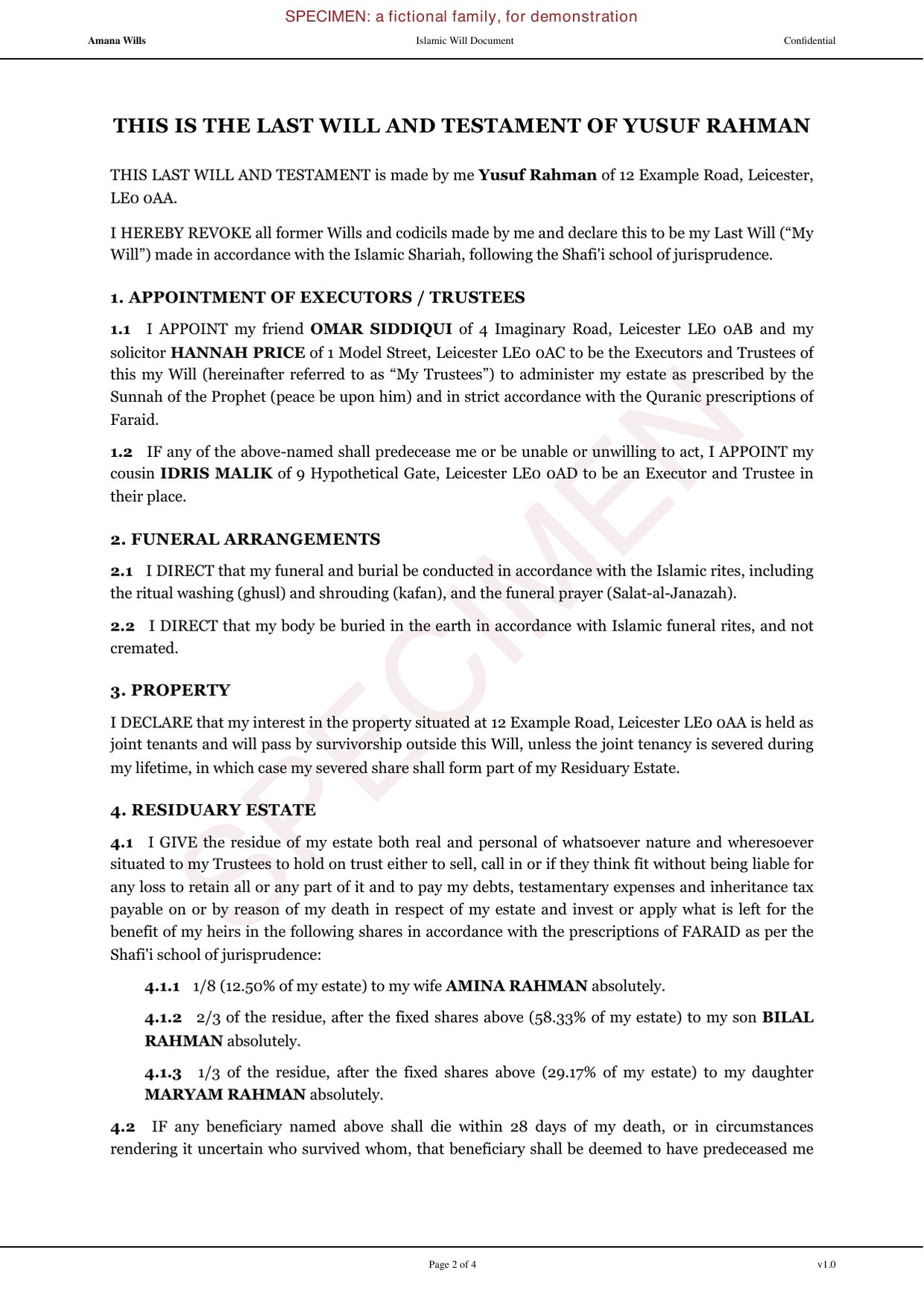
1. Earlier wills revoked, and the madhab named
Every new will cancels the ones before it. This one also records the testator's madhab, the tradition of Islamic law they follow; Yusuf has recorded the Shafi'i madhab. The shares in clause 4 are worked out under the madhab the will names.
2. Two executors
Yusuf names two people to act together: a friend and his solicitor. Executors gather the estate, apply for probate, pay what is owed and distribute by the shares. Two can share the work; one person can be ill, abroad or overwhelmed.
3. A reserve
If either executor cannot or will not act, a named cousin steps in. Tell the people you name. Many executors learn of the appointment at the funeral; the executor card on the table is for this.
4. Islamic rites, and burial
The will asks for ghusl, the kafan, the funeral prayer and burial in the earth, not cremation. The executors are guided by this, but a funeral happens within days, before most wills are read, so the family needs to know the wish as well as the document.
5. The home is not in this will
Yusuf and Amina own the house as joint tenants, so on the first death it passes to the survivor automatically, outside the will and outside the shares. The clause says so plainly, and provides for the other case: if the joint tenancy is severed, Yusuf's half comes back into the estate and is shared under clause 4. Neither way is wrong; one of them is what you meant.
GOV.UK, Joint property ownership: a joint tenant "cannot pass on your ownership of the property in your will".6. Debts and tax first, then the shares
The trustees first pay debts, the funeral and any inheritance tax. Only what is left is divided. The percentages printed in the sub-clauses are shares of that remainder, not of everything Yusuf ever owned.
7. The wife's eighth
Amina takes one eighth because there are children. Without children it would be a quarter. The fraction is the fact; the percentage beside it is a convenience.
Qur'an 4:12.8. Son and daughter, two to one
What remains after the fixed share goes two thirds to Bilal and one third to Maryam: a son's portion is twice a daughter's. Printed here as 58.33% and 29.17% of the estate. A daughter's share is hers absolutely; nobody holds it for her.
Qur'an 4:11.9. Twenty-eight days
An heir who dies within 28 days of Yusuf, or in an accident where nobody can say who died first, is treated as not having survived him, and the estate is shared among the others as if so. Without it, a share could pass to an heir and then, within the month, through that heir's own estate as well.
The text of this page
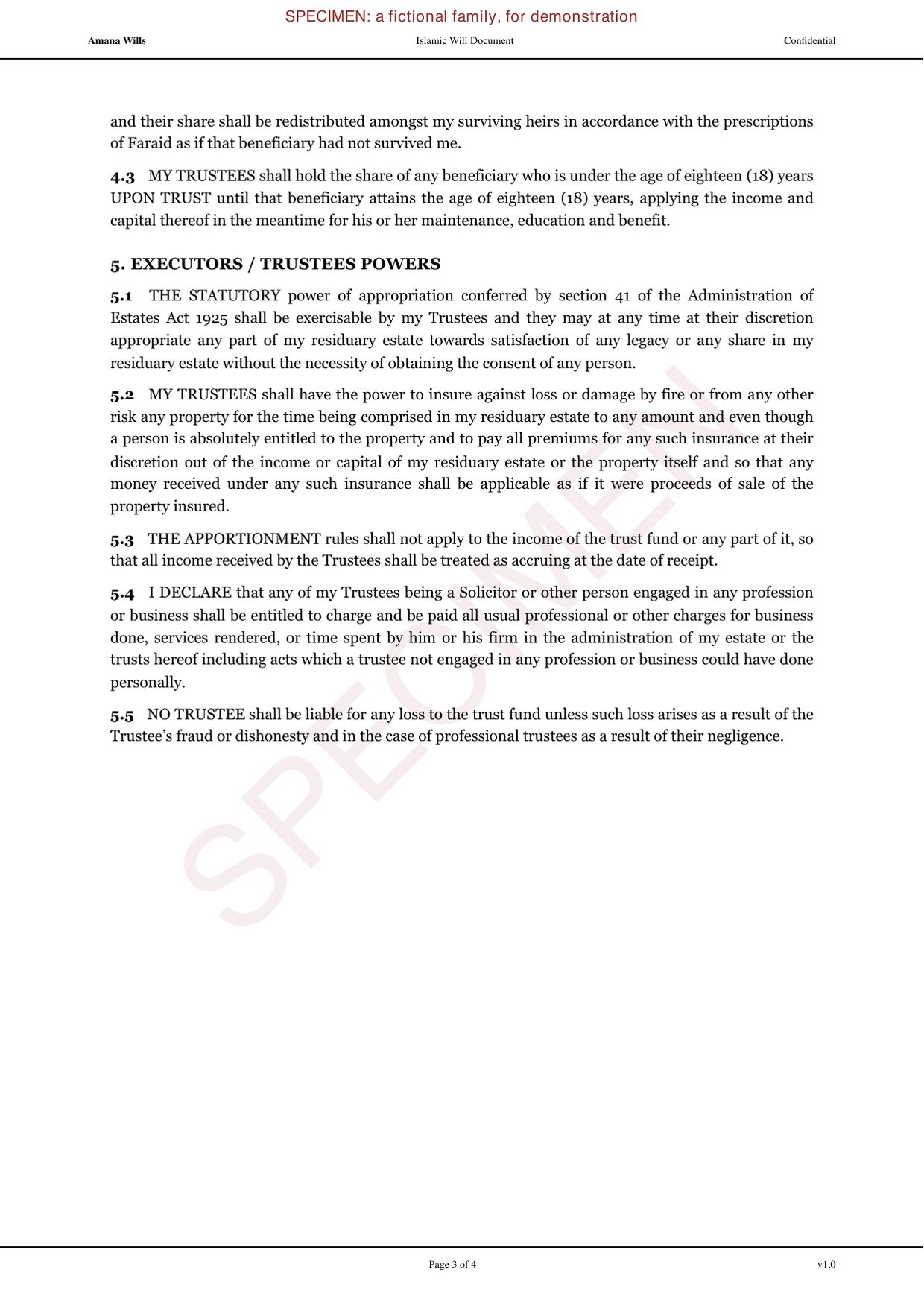
1. Under eighteen
A young heir's share is held on trust until eighteen, and may be spent on their maintenance and education in the meantime. Bilal and Maryam are adults in this specimen, so the clause waits for grandchildren.
2. Ordinary trustee powers
Appropriation (handing an heir a particular asset in satisfaction of a share), insurance and the treatment of income are the standard English machinery that lets executors do the work. None of it changes who gets what.
Administration of Estates Act 1925, section 41, named in clause 5.1.3. A professional may charge
The solicitor executor may charge her normal fees for the administration. The friend cannot be paid for his time unless the will says so; this one does not.
4. What is not in this will
A pension, which is paid under the scheme's rules and the nomination form you signed, not under the will. Jointly held accounts and the home, which pass by survivorship. A life policy written in trust. And a bequest, the wasiyya: up to one third of the estate may go to someone who is not an heir, and this will makes none. Each of these is a conversation with the solicitor, and the first two are the ones families most often get wrong.
The text of this page
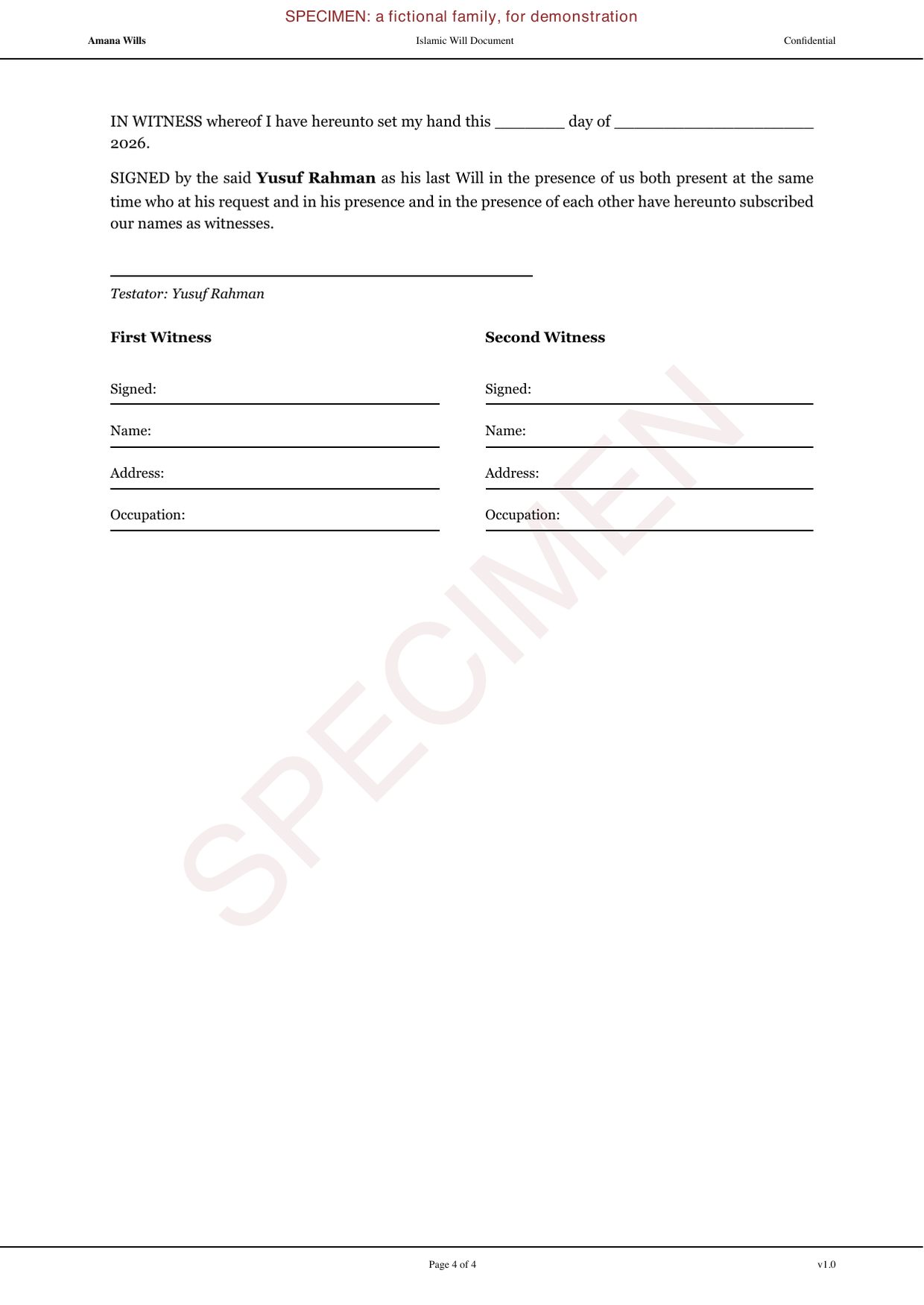
1. The date
Written in by hand on the day. A will speaks from the date it is signed, and later documents are read against it.
2. Two witnesses, present at the same time
The testator signs in the presence of two witnesses who are both there at that moment, and each witness then signs in the testator's presence. That is the rule in the Wills Act 1837 and it still stands: a will cannot be signed electronically, and the video witnessing allowed during the pandemic ended on 31 January 2024.
Wills Act 1837, section 9, legislation.gov.uk.3. The testator's signature
Yusuf signs here, in ink, once both witnesses are watching. If he cannot sign, someone else may sign at his direction in his presence; the attestation clause above is then adjusted.
4. Who may witness
Any adult who understands what they are doing, but never a person who inherits under the will, nor that person's spouse or civil partner: a gift to a witness, or to a witness's spouse, is void. So not Amina, Bilal or Maryam, and not their husbands or wives. A neighbour, a colleague or the firm's staff are the usual choice. Name, address and occupation are recorded so the witnesses can be found years later.
Wills Act 1837, section 15, legislation.gov.uk.
Two and three · the cards
Two cards for the kitchen table
One opens a conversation with your parents; the other tells your family where your will is and whom you asked to deal with it. Both print on an ordinary printer, four to a sheet.
Three questions to ask your parents
Three questions to ask your parents this week
- Do you have a will, and where is it?
Without a will the intestacy rules decide who inherits, and they are not the Islamic shares. A will is the only way the shares happen.
- How is the house held?
Joint tenants: it passes to the survivor automatically, outside any will. Tenants in common: each half can be left by will. Neither is wrong; one of them is what they meant.
- Whose name is on your pension form?
Most pensions are paid under the scheme's nomination form, not the will, and the form may be twenty years old. From 6 April 2027 unused pensions also count for inheritance tax.
General information, not advice. For your own family, speak to a solicitor. Sources on the back.
Where to start

This card, the specimen will read in the margin, and the executor card, to keep.
- Wills surgeries, with a regulated solicitor
Birmingham first, then where people ask. Leave your details with any of us, or online, and we will tell you when a surgery opens in your area.
- Find the pension form
Ask each scheme whom you have named, and when. It takes one phone call, and the answer often surprises.
- Check the title
How the home is held is on the Land Registry title, or ask the solicitor who did the purchase.
Sources: GOV.UK, Joint property ownership · GOV.UK, Inheritance Tax: unused pension funds and death benefits (from 6 April 2027) · Administration of Estates Act 1925, s.46.
Amana Central Ltd, company 17468979 · General information, not advice.
Where my will is
Where my will is
Fill this in and give a copy to each person you name. A will nobody can find is the same as no will.
This card is not a will. It tells your family where the will is and whom you asked to deal with it.
What your executors will need
- The original will
The probate registry needs the signed original, not a copy. The front of this card says who holds it.
- A list of what there is
Accounts, pensions, property, policies, debts, and where each paper lives. One page, kept with this card, saves months.
- Who to call first
The solicitor named on the front, then the family. A pension scheme and a joint owner each have their own forms; the will does not reach them.
Islamic will or not, every executor in England and Wales needs the same three things.
AmanaCentral · amanacentral.com · Amana Central Ltd, company 17468979 · General information, not advice.
Files
Print your own
- The specimen will, read in the marginfour A3 landscape sheets · PDF
- Three questions to ask your parentsA6 card, front and back · PDF
- Three questions, four to an A4 sheetfor an office printer · PDF
- Where my will isA6 card, front and back · PDF
- Where my will is, four to an A4 sheetfor an office printer · PDF
Sources
Where the law in these pages comes from
- Wills Act 1837, section 9 (signing and witnessing) and section 15 (gifts to a witness).
- GOV.UK, Joint property ownership: joint tenants and tenants in common.
- GOV.UK, Inheritance Tax: unused pension funds and death benefits, from 6 April 2027.
- Administration of Estates Act 1925, section 46 (who inherits without a will) and section 41 (appropriation), named in the will's clause 5.1.
- Qur'an 4:11 and 4:12, the fixed shares.